
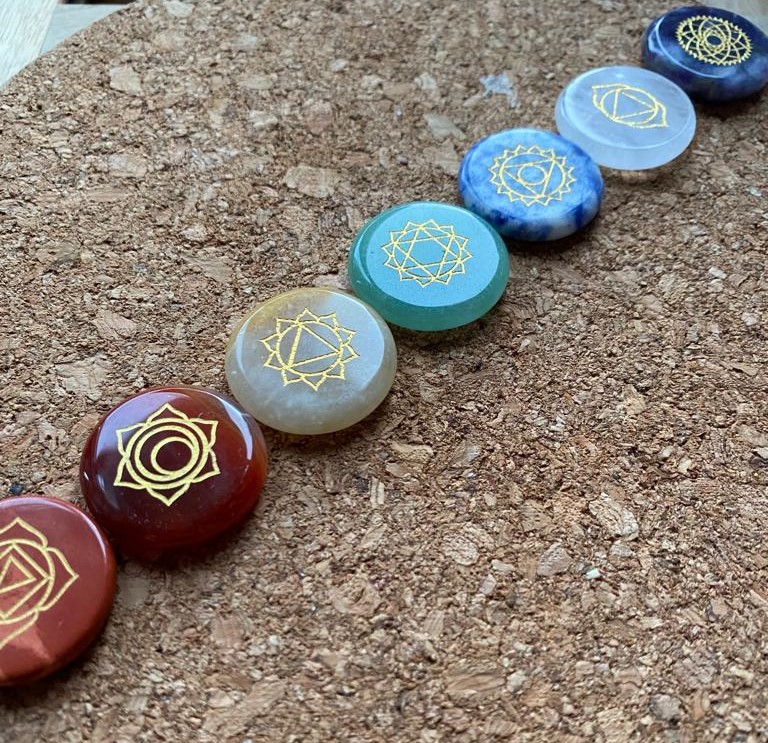
Chakras play a key role in Reiki and other forms of energy healing. Becoming aware of them, identifying any imbalances or ‘blocks’ and learning how to balance them can form an important part of your personal healing journey.
In this post, we explore each of the seven main chakras: what you may experience if a chakra is out of balance or ‘blocked’, what it means when a chakra is in balance, location along the spine, associated element, colour, mantra*, yantra**, crystals, and essential oils.
*a mantra is a word or phrase that you can repeat during meditation to help balance a specific chakra by bringing to light some of the energetic, mental or physical blocks that may be contributing to the imbalance.
**a yantra is a geometrical shape or diagram that you can picture in your mind’s eye during meditation to help balance a specific chakra by bringing to light some of the energetic, mental or physical blocks that may be contributing to the imbalance.
What are chakras?
The word ‘chakra’ in Sanskrit can be translated to ‘wheel’, and chakras are exactly that – spinning wheels of energy. Your chakras form part of your energetic or astral body and your seven main chakras are arranged vertically along your spine, from the ‘root’ at the base, to the ‘crown’ at the top of your head. There are a number of other energetic pathways in your body, including a number of smaller chakras called meridians – a concept in traditional Chinese medicine. Cords of energy emanate from each main chakra, and these can be linked to various things including other Beings, locations and material items.
Unless you are extremely sensitive, you won’t be able to see chakras with your physical eyes, but you may be able to ‘feel’ certain ones on yourself or others.
What does it mean when a chakra is not in balance or ‘blocked’?
An imbalance or block in one or more of your chakras means the energy flowing through them has become overactive or underactive – there may be too much energy, too little energy, or the vibration of the energy may be too high or too low. Chakras can be out of balance due to a number of different reasons, each of which depend on the individual Being and their unique experiences. Imbalances can generally be grouped into healthy and unhealthy archetypal (universally recognised) patterns, and you may find different chakras are out of balance at different times during your life experience.
Using Reiki to balance chakras
I find Reiki sessions a powerful and effective way to balance chakras. Holy Fire ® III energy has a consciousness of its own, and this high vibrational healing energy travels to the area in which it is most needed to stimulate and support the body’s natural healing process. Crystals also play an important role in my healing sessions, and different crystals are associated with different chakras.
You can read more about Reiki sessions with me at ~ A V I N A ~, here.
Other ways to help balance chakras
There are many things you can do instead of or alongside Reiki to help balance your chakras. These include:
- Yoga
- Working with crystals
- Hypnotherapy
- Talking therapy including counselling (spiritual or conventional)
- Aromatherapy – essential oils or incense
- Shadow work
- Sound baths or sound therapy
- Meditation
The seven main chakras
Root (Muladhara)
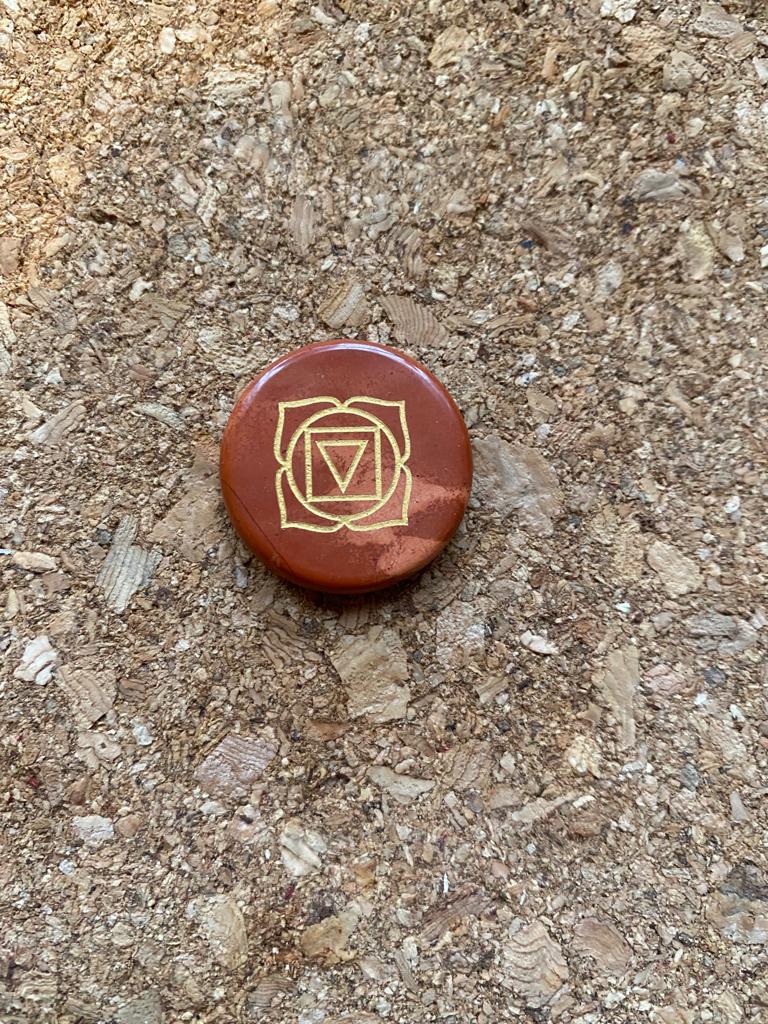
Element: Earth
Location: Base of the spine, between pubic bone and tailbone (perineum)
Colour: Red
Mantra: LAM
Yantra: Golden square
Crystals: Red jasper (as seen in photo), garnet, tourmaline
Essential oils: Juniper, patchouli and cedarwood.
An imbalance may cause you to feel fearful, out of control, experience scattered or disorganised thoughts, find it difficult to make decisions, experience feelings of financial insecurity, unhealthy eating habits, and/or you may have ongoing problems with family members, parents or children.
The root chakra is your source of power, and relates to the feet, legs and pelvic floor. It is your connection to Mother Earth, and it determines your relationship with the material or physical world.
When your root chakra is balanced you feel a great sense of safety and security. You are aware of the eternal abundance of the universe which flows readily to you. You are comfortable with the material world, and you have a healthy relationship with family members and to material possessions. You feel content and grateful with all that you have and experience in your life.
Sacral (Svadhisthana)
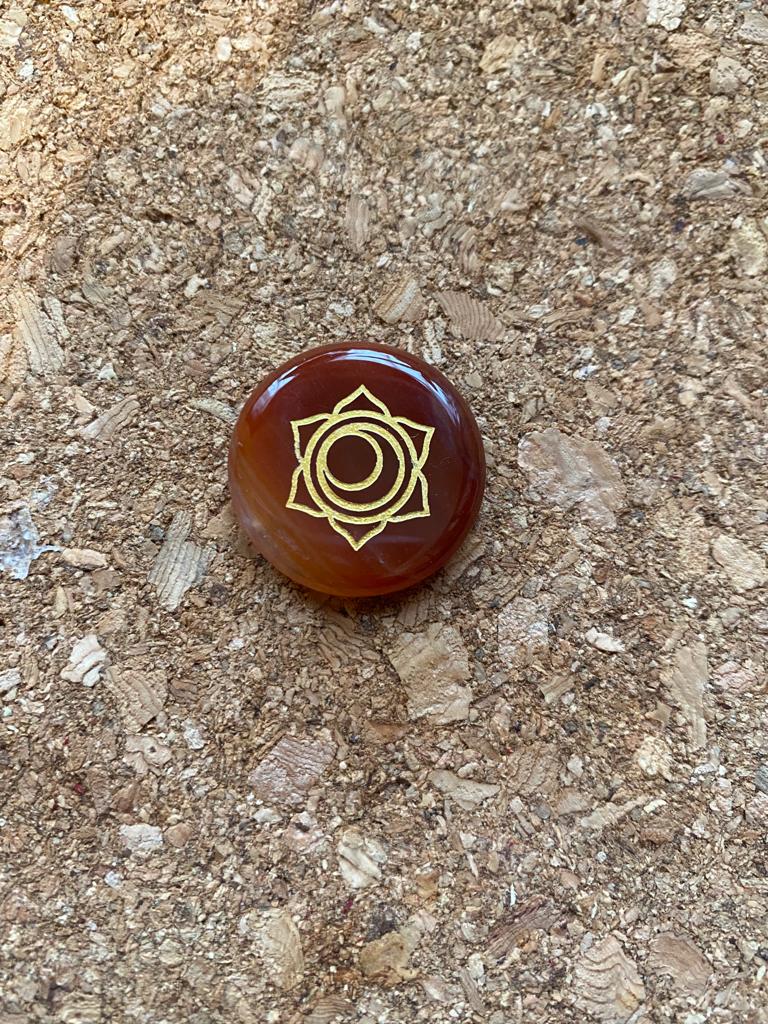
Element: Water
Location: Pelvic basin, lower abdomen, below the navel
Colour: Orange
Mantra: VAM
Yantra: Silver crescent moon
Crystals: Carnelian (photo), moonstone, tigers’ eye
Essential oils: Sandalwood, orange, ylang-ylang.
An imbalance may cause you to find difficulty in sustaining relationships or connections with the different aspects of yourself or with others, a lack of desire, you may make resolutions and not carry them out (lack of willpower) and/or you may experience addictive, compulsive or obsessive tendencies.
The sacral chakra is associated with the element of water and is the home of your unconscious or subconscious mind – your Shadow Self, a concept coined by Swiss psychiatrist and psychoanalyst, Carl Jung.
In his book, Chakra Yoga, Alan Finger says “Water holds enormous power. When it is stored and directed, it can do all sorts of things from making electricity to grinding corn. But if it is dispersed, it loses its potency. If you can learn to effectively harness and channel your water element in this (sacral) chakra, you can overcome the patterns of your unconscious mind and find greater fulfilment in life.”
Working with your Shadow Self is an effective way to help balance this chakra. More about this in a later blog post!
When your sacral chakra is balanced you feel more open to the world around you. You have a healthy relationship to sex, and you feel emotionally stable and centred. You accept, love and have compassion for the many different aspects of yourself, including the unconscious patterns and behaviours of your shadow, which you have integrated into your life in a healthy way.
Solar plexus (Manipura)
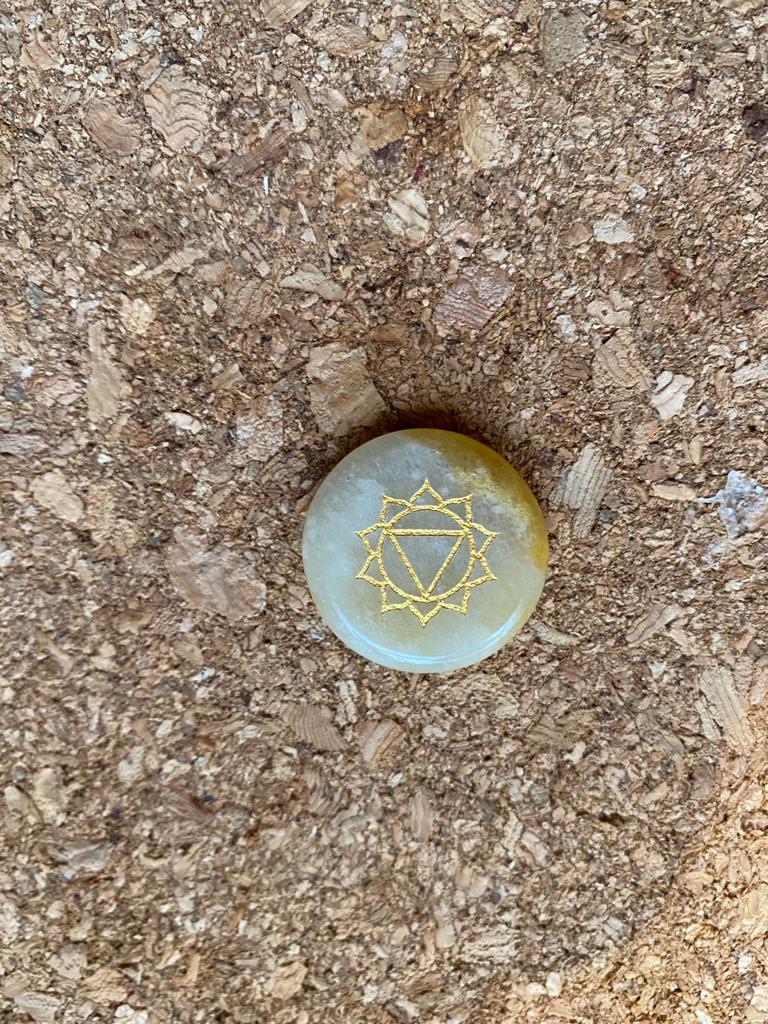
Element: Fire (city of gems)
Location: Solar plexus – above the navel, upper abdomen, middle back
Colour: Yellow
Mantra: RAM
Yantra: Red, downward pointing triangle inside a circle
Crystals: Citrine (photo), sunstone and pyrite
Essential oils: Ginger, mandarin and cinnamon.
An imbalance may cause you to have trouble making decisions, feel nervous in group situations, suffer from low self-esteem and self-doubt, engage in self-destructive behaviour, have a tendency to always be right no matter the argument, be insensitive or intolerant and/or have a hard time working with others.
When your solar plexus chakra is balanced you can see the world more clearly. Your ego does not need continual gratification. Your relationship with the world is comfortable and authentic – you are living in line with your soul purpose or destiny.
Heart (Anahata)
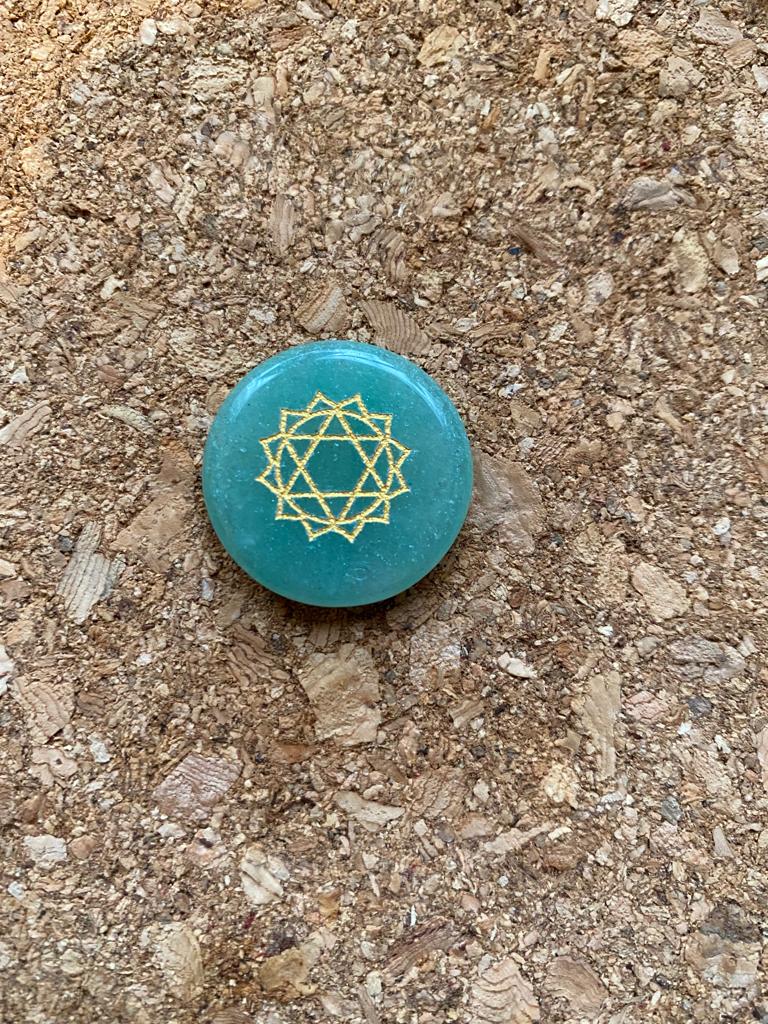
Element: Air
Location: Heart space, centre of chest, upper back
Colour: Green
Mantra: YAM
Yantra: Two, powder blue overlapping triangles, one pointing up, the other pointing down to form a six-pointed star
Crystals: Aventurine (photo), rose quartz and malachite
Essential oils: Rose, bergamot and pine.
An imbalance may cause you to have trouble finding meaning in your life, find it hard to relate to others, be overly emotional, dislike being alone with your feelings and thoughts, cause you to always look to others to fulfil your emotional needs and you may be easily disappointed with yourself and others.
When your heart chakra is balanced you find more harmony between the dualities of life – the internal and external, the physical and spiritual. You are compassionate, kind and understanding of yourself and others. You do not need validation or love from external sources because you know that all you need is already within you.
Throat (Vishuddha)
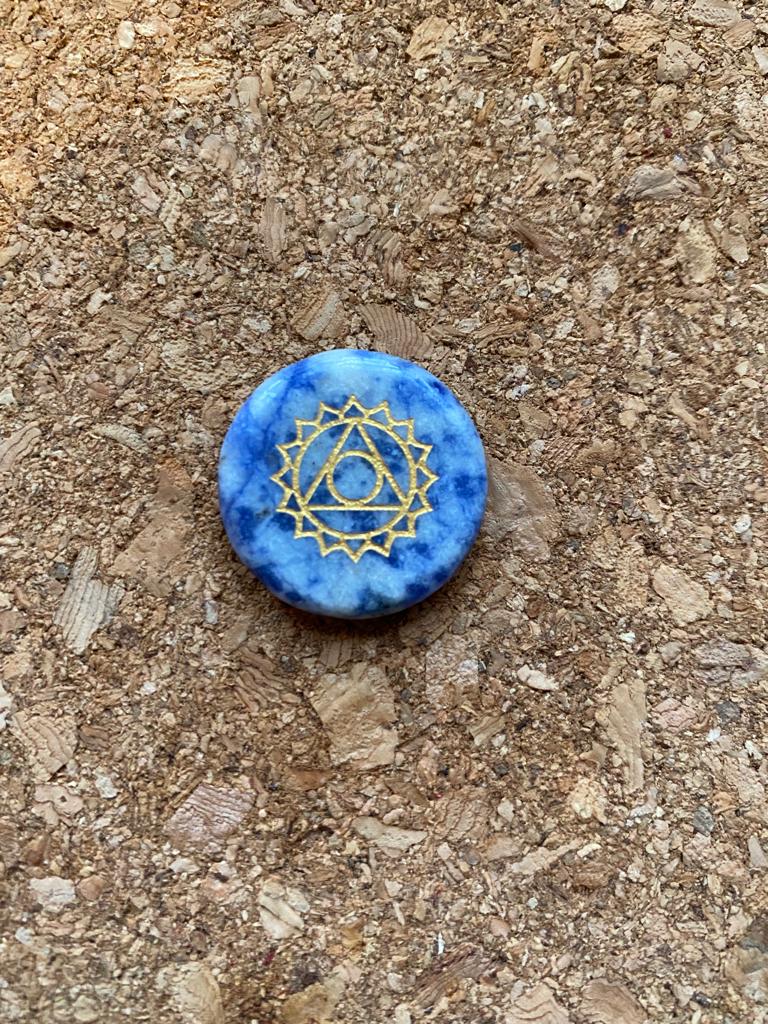
Element: Space
Location: Throat, back of neck
Colour: Blue
Mantra: HAM
Yantra: White circle with a smoky grey oval in its centre
Crystals: Sodalite (photo), lapis lazuli and aquamarine
Essential oils: Peppermint, ylang-ylang and chamomile.
An imbalance may cause you to be aggressive and overbearing, you may dominate conversations, or you may be withdrawn and not be able to speak up for yourself. You may not be able to effectively communicate your needs and boundaries, which may lead to feelings of anger and frustration. You may find you do not live a life that is in line with your core beliefs and values, or you may not be aware of them yet.
When your throat chakra is balanced you speak your truth, and you are your authentic self in all situations. You communicate clearly and effectively, setting clear boundaries, and you feel comfortable and worthy of asking for and receiving Divine Guidance to aid you in serving yourself and other Beings.
Third eye (Anja)
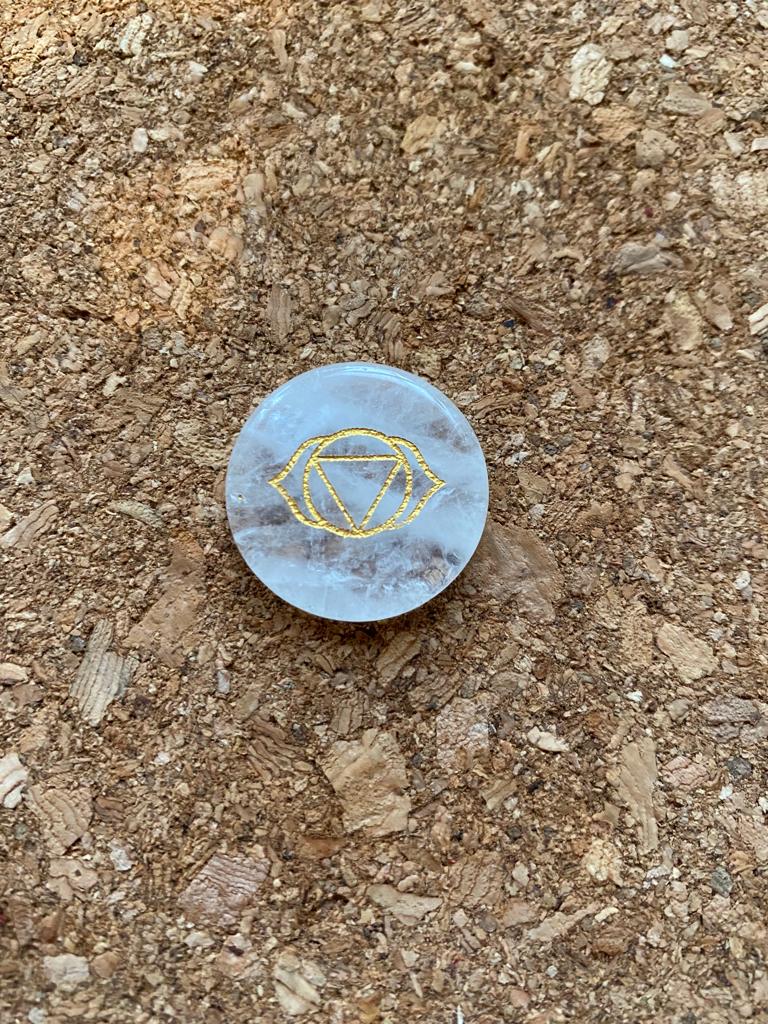
Element: Command centre of the elements
Location: Third eye, space between eyebrows and towards centre of forehead
Colour: Violet
Mantra: KE-SHAM
Yantra: A downward pointing triangle, surrounded by a circle with two petals at either side
Crystals: Clear quartz (photo), amethyst and labradorite
Essential oils: Lavender, clary sage and sandalwood.
The third eye is different to the other chakras in the sense it cannot be balanced or imbalanced – it is either open or closed. It is the source of inner vision, our connection to the Divine, and it regulates our other six chakras. It is strongly associated with the Law of Karma.
When karma is worked through and released, it leads to inner growth. When it is not, situations or patterns will continue to reoccur until a lesson has been worked through. Do you find the same pattern repeating itself over and over again in your life? Do you attract the same sorts of relationships or people, or are you stuck in a relationship you know isn’t good for you, but you can’t seem to walk away? You may have lessons that need to be learned and karma that needs to be released or worked through. If you continue to respond in the same way, you will be unable to move forward and release your karma.
You always have a choice, but there is no right or wrong one. Karma may be considered a bad thing, but there is both good and bad karma, and even the bad means there are invaluable experiences to be had and lessons to be learned which ultimately leads to growth on a soul level.
Crown (Sahasrara)
Element: Beyond the elements
Location: Crown, top of the head
Colour: White
Mantra: OM
Yantra: A thousand petal lotus
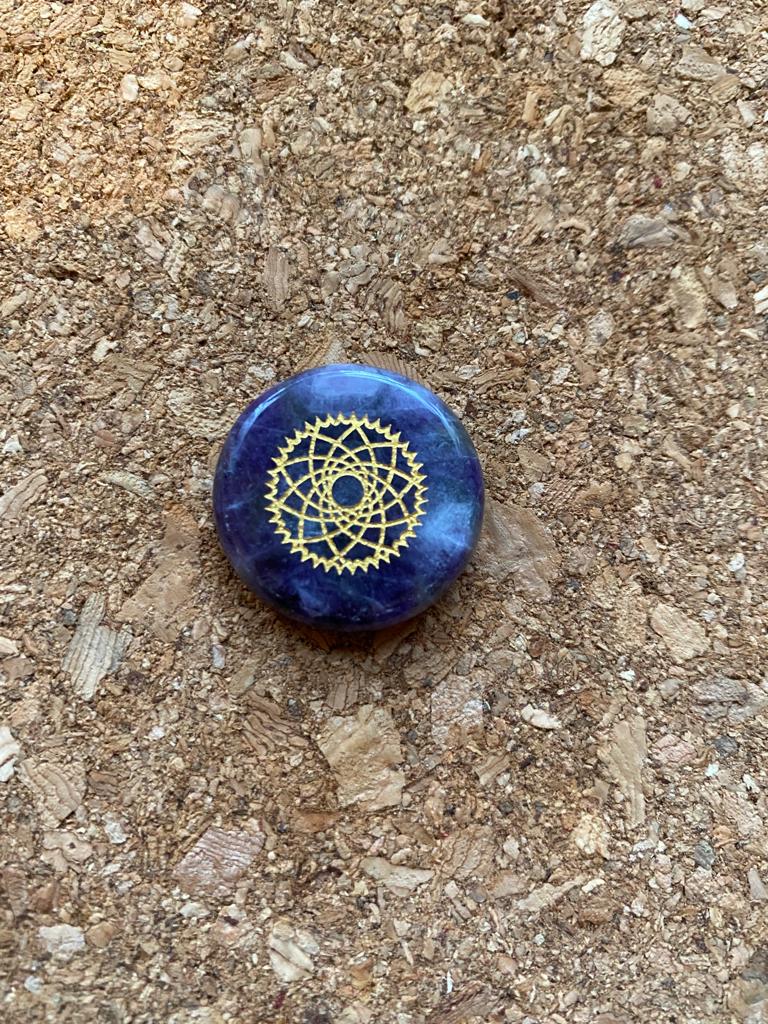
Crystals: Amethyst (photo), selenite and clear quartz
Essential oils: Frankincense, jasmine and myrrh.
This chakra is represented by the thousand-petal lotus flower. The crown chakra directs energy down into the third eye chakra, where it is combined with karma and the elements and distributed to the other five chakras. The crown chakra opens fully when the other chakras are balanced. It is important to ensure your root chakra is balanced, before attempting to work on your crown chakra. Many recreational drugs will open your third eye and crown chakra, and without careful use, can cause complications if you are not properly grounded.
Further reading
Some of the information in this post has been taken from the book Chakra Yoga by Alan Finger. I would highly recommend this book – in addition to information about each chakra, Alan gives in depth information about the history and background of the chakra system, creation, tantra, the history of yoga and the best poses, mantras and yantras to help balance each chakra.
Thank you for reading. If you have any questions, click here and ask away.
If you enjoyed it, feel free to follow my Facebook page (here) for inspirational quotes, regular blog posts and other updates, or subscribe to my newsletter below.
Didn’t resonate? Discard it!
 Barberry and Bloom Holistic Therapies
Leave a comment