
I use the Theosophical teachings as a guide, a structured way to help me to navigate the complex nature of the higher realms. It also gives me an explanation for some of the experiences I have had and continue to have on my healing journey.
Divine wisdom
The word ‘Theosophy’ comes from the Greek word ‘theosophia‘ – ‘theos‘ which means ‘gods‘ or ‘divine‘, and ‘sophia’ which means ‘wisdom‘. It can therefore be translated to ‘divine wisdom‘. This word was first used in writing during the 3rd-6th century (of this era) by Alexandrian Neo-Platonic philosophers and they used this term to indicate a experiential knowledge that came through spiritual means, not intellect.
Theosophy is not a religion, but a universal ancient or timeless wisdom, a philosophy or ‘spiritual science’. This timeless wisdom underlies all religions and belief systems, because when you strip them right back to their core – you will find they are all fundamentally, the same. Theosophy can be practiced by people of any religion, belief system, background, sex, gender and race.
The basic principles of theosophy
- EVERYTHING is ONE. Behind everything we can see (and that which we cannot) is an eternal, incomprehensible energy. This energy pervades and sustains the entire Universe, and it manifests itself in an infinite number of ways to experience itself and ultimately expand it’s awareness and consciousness.
- Everything in the Universe works in cycles. The entire Universe manifests, develops and dissolves back into this one, eternal energy. A period of creation is called a manvantara. A period of rest is called pralaya (like day and night, life and death, inhale and exhale).
- ‘As above, so below’. The same processes exist in both the macrocosm (the large – the cosmos, planets) and the microcosm (the small – humans, animals, plants down to a single atom).
- Everything in the manifest Universe is a duality. Spirit and matter, day and night, life and death, male and female – two polarities of the one and everything in between.
- We live in a vibrational Universe. The visible Universe of matter – that which we can see every day – is the densest plane with the lowest vibration, of a number of different planes of Being. There are seven planes, according to Theosophy, and they are all made up of different vibrational frequencies.
- The Universe has a purpose, and everything in it evolves according to a ‘Divine Plan’. Life moves in an ever more expressive form, and with this comes increased awareness and consciousness.
- Each Being has within them a ‘divine spark’. This is our essence, our soul or true self. This is an individuated part of the one eternal being.
- There are a number of Universal Laws – of which Karma is one. Karma is unavoidable, and everything in the Universe answers to it. It is also known as the Law of Cause and Effect. There are always consequences (good or bad) to actions – whatever we sow, we will eventually reap.
- The cycle of reincarnation is also ruled by the law of Karma. We continue to reincarnate onto the physical plane (for our physical experience) where we can straighten out our past and future karmas which we have accumulated due to our free will as humans. We ‘weave our own destiny through the ages’. Eventually we will become Gods.
- The human pilgrimage takes us from the Source – the One Eternal Being – of which we are originally an unconscious part of, leading us through the experience of the many on each of the seven planes, to finally take us back into union with the One Eternal Being, but now in full awareness and expanded consciousness.
- The ultimate goal of each and every Being is to complete this cosmic cycle of manifestation through which we attain a fully conscious realisation of ourselves as an integral part of the One Eternal Being, no longer polarized between consciousness and matter, or divided into self and other. This realization is also known as enlightenment.
The Theosophical Society (TS)
In 1875, Madame Helena Petrovna Blavatsky (HPB) and a group of like-minded people founded The Theosophical Society (TS). The TS headquarters can be found in Adyar, India; and today there official sections in over 70 different countries worldwide.
The emblem
The emblem of the TS was adapted from the personal seal of Madame HPB. The emblem contains a number of different ancient symbols, including:
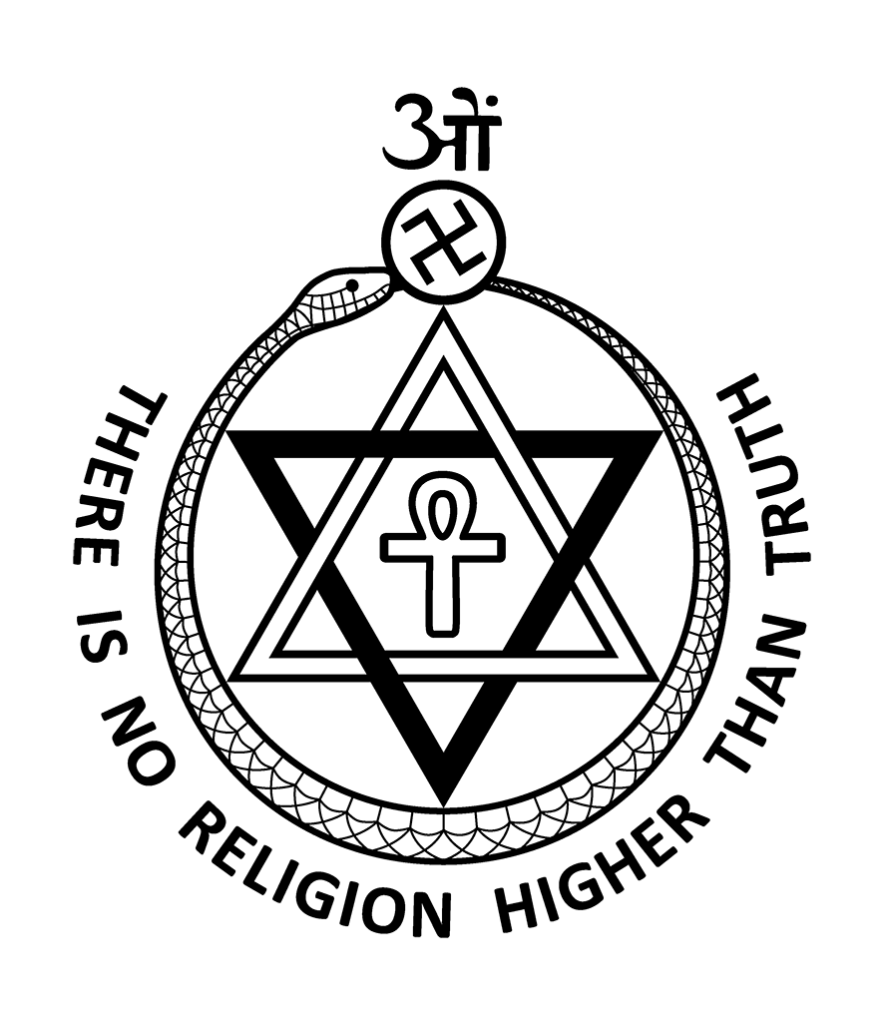
- Aum (very top). Pronounced ‘om’. This sacred word in India cannot be translated to English because it has symbolic meaning – the divine origin of all things.
- The snake swallowing it’s tail or ‘ouroboros’. This symbolises eternity and cyclic time. It represents wisdom, regeneration and rebirth.
- The whirling cross or swastika. A Sanskrit word meaning ‘well-being’, a symbol of good fortune found in the birthplace of ancient cultures including India, China, Japan, Greece and Rome.
- Interlaced triangles. Known as King Solomon’s seal or star, and in India – the seal of Vishnu. The interlaced triangles represent duality – spirit and matter, male and female. The upward triangle represents spirit and the downward triangle, matter.
- The Ankh (middle of star). A sacred symbol associated with ancient Egypt, symbolising life, regeneration, and the decent of spirit into the world of matter (the physical plane).
- The motto – There is no religion higher than truth. An English translation of a Sanskrit motto, meaning none of our commitments, social conventions or ideas can measure up to the reality of what truly is.
As a whole, the emblem represents a spiritually reborn person, and on a larger scale, the universe expanding into manifestation.
You can read about the symbols in more detail, here.
Read more about the Theosophical Society in England and Wales, their mission and objectives here.

World Federation of Young Theosophists (WFYT)
The WFYT was re-established in 2022.
It is a wonderful group of young people, all under the physical age of 40 years old. This group aims to create content and events that can engage all young theosophists, helping them to connect, to discover their talents and know their individuality, so that they may live a theosophical-led life.
You can read more about the WFYT, here.
A list of international theosophical organisations
Here you can find a directory of theosophical organisations and centres from around the world.
Thank you for reading. If you have any questions, click here and ask away.
Sign up to my newsletter or follow me on Facebook to read my next blog post – ‘Why does Theosophy resonate with me?’
Didn’t resonate? Discard it!
 Barberry and Bloom Holistic Therapies
Leave a comment